When you work in Cash and Voucher Assistance (CVA), you quickly learn that you cannot do everything alone. Cash is one of the most flexible, powerful forms of humanitarian aid, but it also requires careful coordination. Without it, we risk duplication, inconsistent transfer values, or even worse, leaving the most vulnerable behind. That is why cash coordination platforms like the Cash-Based Interventions Technical Working Group (CBI TWG) in Türkiye are a cash practitioner’s best friend.
As a member of Türkiye’s CBI TWG and its Technical Advisory Group (TAG), I have witnessed first-hand how coordination brings accountability, harmonization, consistency, and technical strength to cash assistance programming. In this post, I want to unpack what makes cash coordination so valuable and why practitioners should embrace it as an essential part of their work.
Why Cash Coordination Matters?
A Cash Working Group is a space where organizations meet to share, learn, and align. INGOs, UN agencies, local NGOs, donors, and public institutions come together to discuss how cash is delivered, what gaps exist, and how to avoid duplication.
Meetings are not just information exchanges; they are problem-solving mediums for us. For example, as several members we recently presented our experiences with Financial Service Providers (FSPs). The summary note that came out of this exercise is now a reference point for all partners, saving everyone time and helping organizations choose the right FSP for them.
Coordination also supports referral pathways. Our own field teams once identified and assisted a GBV-sensitive case through our Cash for Protection assistance. By the time our Multi-Purpose Cash Assistance (MPCA) was completed, and we referred the family to another organization providing cash for basic needs. Without a functioning Working Group, this kind of collaboration would be far harder, especially if the scale of the humanitarian response is large, which is the case for Türkiye.
Accountability Through Transparency
Cash is accountable when it is predictable, transparent, and fair. Cash coordination mechanisms create that accountability. By coming together under one platform, organizations agree on guidance notes, targeting criteria, and transfer value calculations. This makes cash assistance consistent no matter how many are there.
The MPCA Guidance Note (July 2025), prepared by CBI TWG, is a very good example. It provides updated transfer value recommendations based on the Minimum Expenditure Basket (MEB), inflation data, and market-based rent analysis. When every partner aligns with the guidance, beneficiaries receive a well-aligned support even though there are several organizations providing MPCA.
This alignment is more than technical housekeeping. It ensures fair assistance, prevents tension in communities, and demonstrates to donors and authorities that cash is being delivered in a harmonized, responsible way.
The Role of the MEB and Transfer Value Calculations
One of the biggest contributions of cash coordination is in defining and updating the MEB and transfer values.
The MEB represents the average monthly cost of a household’s basic needs, including food, rent, utilities, health, and education. It is the baseline used by CBI TWG to guide MPCA transfer values.
By rooting transfer values in real, up-to-date market and rent data, coordination ensures assistance is evidence-based, consistent, and credible.
Building Technical Capacity
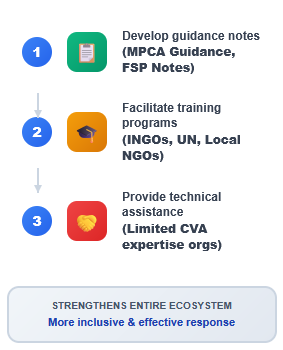
Cash coordination is not only about avoiding overlaps. It also builds the technical capacity of practitioners. Within the CBI TWG, we regularly:
- Develop guidance notes (like the MPCA Guidance or FSP Note)
- Facilitate trainings for cash practitioners in INGOs, UN agencies, and especially local NGOs
- Provide technical assistance to organizations with limited in-house CVA expertise
These efforts strengthen the entire humanitarian ecosystem. Local NGOs, which often have the deepest community access but fewer technical resources, can rely on the TWG for support. This creates a more inclusive and effective response.
Preventing Duplication and Expanding Reach
One of the practical but often overlooked benefits of cash coordination is deduplication. In Türkiye, two key tools are used:
- Cross-check mechanism against the world’s largest humanitarian cash assistance programme, SSN (Social Safety Net), which is done in coordination with Turkish Red Crescent (TRC) – the implementing partner of the programme
- UNHCR’s Deduplication Platform, a secure, ID-based system for encrypted cross-checks between partners
By using these tools and sharing programme updates in Working Group meetings, we can ensure that families are not receiving multiple cash grants from different organizations while others remain unassisted. This allows scarce resources to be utilized in the most efficient way possible and ensures that assistance reaches a wider set of unique beneficiaries.
A Community of Practice
Cash coordination creates something just as valuable: a community of practice. Practitioners share not only challenges but also best practices. From learning how another organization negotiated fees with an FSP, to hearing innovative approaches to winterization (or other seasonal/anticipatory actions), these exchanges enrich everyone’s programming.
It also provides a channel for collective advocacy. When CBI TWG raises concerns about the impact of sudden CBI phase-outs (for example after the USAID cuts) or inflation-driven gaps, channeling the advocacy needs and efforts through its members helps the humanitarian and development agencies to amplify our voices.
Coordination is Not Optional
For anyone working in CVA, cash coordination is a necessity. It ensures accountability, strengthens technical quality and technical capacity, prevents duplication, and ultimately makes cash assistance more impactful.
Being part of a Cash Working Group means being part of something bigger than your own project. It is about shaping a collective humanitarian response that is harmonized, transparent, and responsive to the needs of the people we serve.
For me, as a practitioner and as a member of Türkiye’s CBI TWG and TAG, this coordination has been an invaluable ally. Cash assistance might be king in humanitarian response, but coordination is its crown (I am assuming that nobody is disagreeing the fact that cash assistance is the king).
Have you benefited from cash coordination mechanisms in your own projects? I’d love to hear your experiences in the comments.
You can also check my other blog posts here.
Leave a Comment