In my last blog post, I explained why every cash assistance project, no matter how big or small, needs an SOP. In fact, writing a clear cash assistance SOP is not just about donor compliance or paperwork. It is about making your project run smoother, avoiding chaos, and keeping everyone on the same page. In this post, I want to shift from “why” to “how.” How do you actually write an SOP for a cash assistance project that is useful, practical, and something your team will truly use and not just a document that sits in a shared folder collecting digital dust?
Why You Should Have a Solid SOP Before Implementation
I’ve said it before, but it’s worth repeating: starting implementation without an SOP is like going on a road trip without a map. You’ll get moving, maybe even as planned, but sooner or later the project will lose direction. An SOP is your project’s safety net; it ensures that even if staff changes, priorities shift, or unexpected issues arise, the team has a consistent reference. Donors love it, auditors appreciate it, and staff feel more confident when they know exactly what to do and when.
In fact, during our recent MPCA project in earthquake-affected provinces in Southeast Türkiye, the SOP became our backbone. Every question about targeting, delivery, reconciliation, or complaints was already answered in the document. This saved us countless hours of ad-hoc calls and last-minute problem solving attempts.
What to Include: Outlining the Content
When drafting an SOP, the trick is not to overcomplicate it but to make sure all critical elements are covered. Here’s a detailed breakdown of what to include:
1. Introduction and Purpose
- Explain why this SOP exists. For example, is it for harmonizing with sector standards?
- Clarify the scope (e.g., one province, one-off distribution, or a multi-month, multi-location intervention).
- Mention the objectives: standardization, accountability, efficiency, compliance, and beneficiary engagement.
2. Program Overview
- Short background: What problem are you solving? What is the donor’s expectation? This is directly in line with your project document.
- Key activities and timeline (registrations, transfers, monitoring, lessons learned).
- A simple process flow diagram can help the team visualize how all steps connect.
3. Targeting and Selection
- Eligibility criteria (who qualifies, who doesn’t, how you score vulnerability).
- Verification steps: ID checks, household visits, deduplication.
- Referral pathways (what you do with non-eligible applicants, e.g., linking to another service).
4. Transfer Value
- How the transfer value is calculated (MEB, rent, winter top-up, household size).
- Reference sector coordination (Cash Working Group guidance, Sphere standards, or donor rules).
- Include a clear table of amounts per household size (field teams use this constantly).
5. Cash Delivery Mechanism
- Chosen Financial Service Provider (FSP) (bank, e-voucher, mobile money, hawala) and why.
- Security measures (ID verification, sweepback process, ATM limits, SMS notifications).
- Step-by-step cash delivery process flow (from beneficiary list preparation to fund release by FSP).
6. Roles and Responsibilities
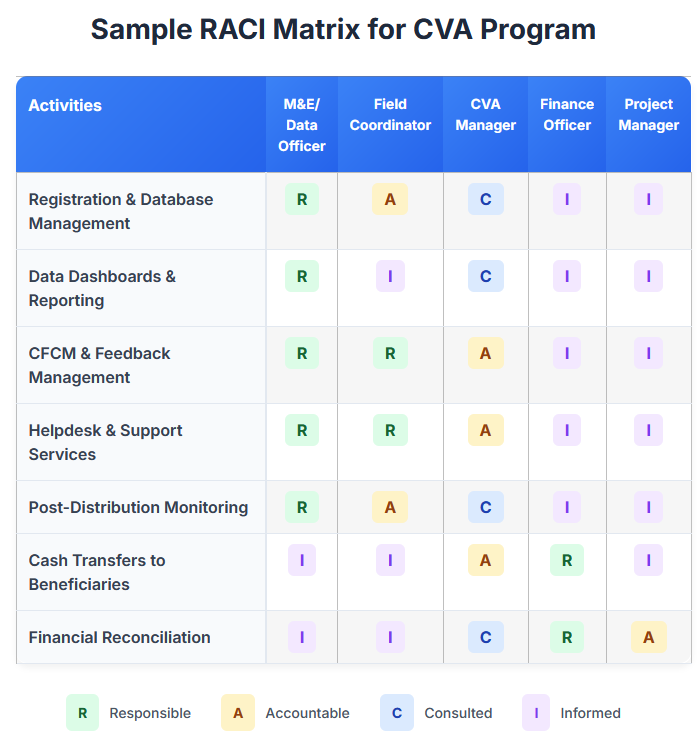
- This is where the RACI (Responsible, Accountable, Consulted, Informed) matrix becomes a game changer. For example:
- Programme drafts the beneficiary list (Responsible).
- Finance uploads payment instructions (Accountable).
- MEAL checks accuracy (Consulted).
- Senior management reviews reconciliation reports (Informed).
7. Reconciliation
- List of required reports from FSP: payment lists, upload reports, withdrawal reports, sweepbacks.
- Step-by-step reconciliation checks: duplicates, dormant transfers, mismatches.
- Corrective actions: how to respond if irregularities are found.
8. MEAL (Monitoring, Evaluation, Accountability, Learning)
- Post-Distribution Monitoring (PDM): sample size, indicators, frequency.
- Feedback and Complaints Mechanism (CFCM): hotline, helpdesk, field visits.
- Reporting: internal monthly reports, donor reports, regularly updated visual (e.g. PowerBI, Tableau) reports, lessons learned workshops.
9. Risk Management and Mitigation Measures
- Operational (delays, access restrictions).
- Security (crowds at branches, protection risks such as GBV risks).
- Market (inflation).
- Data protection (GDPR, digital security).
10. Data Protection and Confidentiality
- Where data is stored, who can access it, retention policy.
- Consent forms and information sheets for beneficiaries.
- Clear reference to GDPR or local data protection law (e.g. KVKK in Türkiye).
11. Coordination and Collaboration
- Internal: programme, finance, MEAL, field staff.
- External: FSP, donors, government, Cash Working Group, NGOs.
12. Review and Updates
As I mentioned in my previous blog post: “Why Every (Cash Assistance) Project Needs an SOP?”, treat your SOP as a living document and detail
- who reviews the SOP, how often, and how changes are communicated.
13. Annexes
- FAQ page for field and CFCM teams.
- Templates (beneficiary assessment/scoring questionnaire, reconciliation checklists).
- Brochures or handouts (feedback mechanism flyers).
Best Practices When Writing an SOP
Writing an SOP isn’t just about putting procedures on paper. It’s about creating a tool that staff will actually use. Here are my best practices from the field:
1. Co-create with your team
- Don’t lock yourself in a room and draft it alone. Bring Finance, MEAL, and field staff to the table.
Example: In one project, field teams pointed out how long would it take to assess one household through our assessment questionnaire. If they weren’t consulted, we would have had been very behind of our initial schedule.
2. Use RACI Matrix
- RACI stands for Responsible, Accountable, Consulted, Informed.
- It avoids confusion like “I thought MEAL was doing that” or “Wasn’t that Finance’s job?”
- Even a simple one-page RACI table brings incredible clarity.
3. Write it for the field, not just HQ
- HQ loves theory, but field staff need a more practical guidance.
- Replace vague lines like “inform beneficiaries in advance” with “MEAL sends SMS in Turkish and Arabic at least 3 days before cash transfers.”
4. Include MEAL from the start
- Too many projects treat MEAL like an afterthought.
- If you build PDM, feedback mechanisms, and accountability into the SOP, you save yourself a lot of stress later.
5. Keep it simple and visual
- Use flowcharts, tables, and checklists. Staff in the field won’t read 10 pages of instructions during a busy distribution.
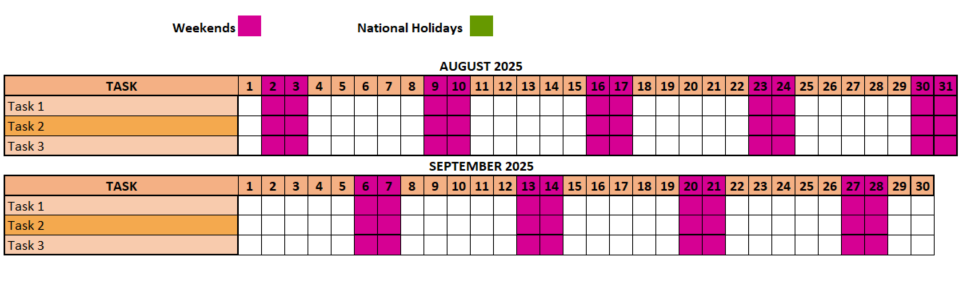
- I always prepare Gantt Charts that would show each month’s activities, as well as national holidays and weekends. This way both HQ and field can plan better.
6. Add an FAQ page
- Ensures CFCM officers, hotline staff, and field teams all give the same answers to beneficiaries.
- Builds consistency and trust; two things that make or break a cash project.
7. Treat the SOP as a living document
- Don’t be afraid to update it. After every PDM or Lessons Learned workshop, check if adjustments are needed.
- I like to keep a “version history” at the start of the SOP to show when and why updates were made.
Why I Add an FAQ Page?
One of the most underrated elements in an SOP is a Frequently Asked Questions (FAQ) page. And this one is not for donors. It is for the people who face beneficiaries every day; field staff, hotline officers, CFCM teams.
Beneficiaries will ask the same questions over and over:
- Why am I not eligible?
- How much will I receive?
- When will the payment be made?
- Where can I withdraw the money?
Instead of each officer inventing their own answer, the FAQ ensures everyone speaks with one voice. It reduces confusion, saves time, and builds trust.
Final Words (I promise)
Writing an SOP doesn’t need to be painful or bureaucratic. My advice is simple: start small, keep it practical, and involve your team. Once you see how much smoother your project runs, you’ll never want to launch a cash assistance activity without an SOP again.
And if you haven’t read it yet, check out my earlier post Why Every Cash Assistance Project Needs an SOP?, that’s where I explain the “why.” This post covers the “how.” Put them together, and you’ve got a strong foundation for any future cash assistance project. You can find a wide range of reference documents online, too. Here is an example for your search.
If you’re drafting your first cash assistance SOP or improving an existing one, I’d love to hear what worked for you. Drop your thoughts in the comments!
Additionally, you can find a CVA SOP Template and Gantt Chart Template in the Resources section, click here to see.
Leave a Comment